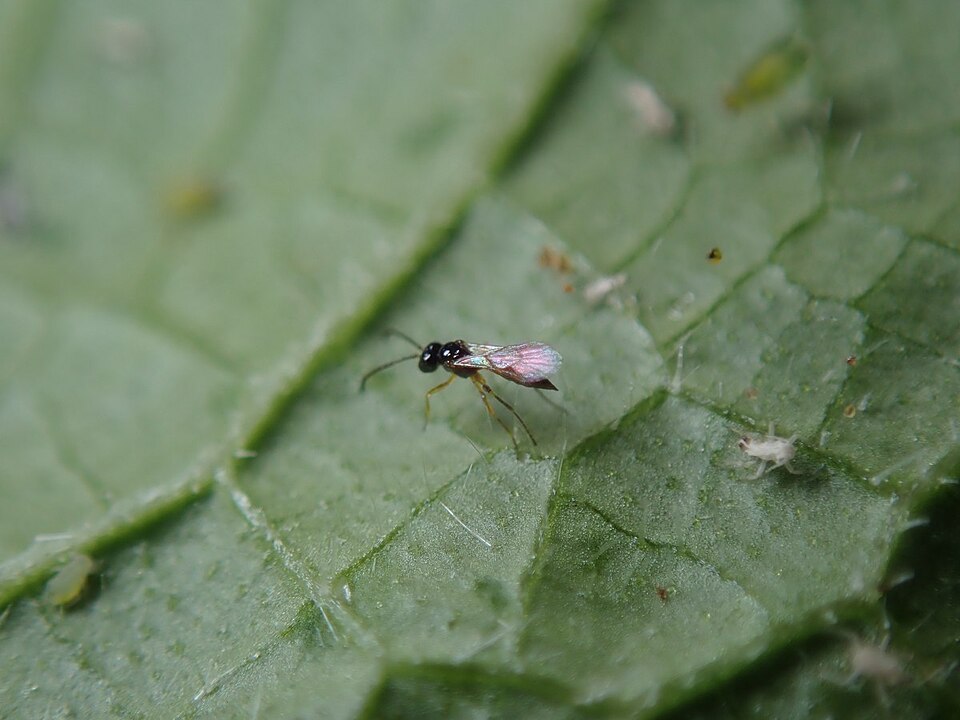
Aphidius colemani
Overview
Aphidius colemani is one of the most widely used parasitoid wasps for aphid control in protected crops. It is particularly effective against smaller aphid species and forms the foundation of many preventative and early curative aphid management programmes.
The wasp lays eggs inside aphids, eventually producing characteristic aphid mummies that indicate successful establishment.
Type
Parasitoid wasp.
Target Pests
Primary Targets
- Melon aphid (Aphis gossypii)
- Cotton aphid
- Small aphid species
Secondary Targets
- Various other susceptible aphids
Identification
Adults are small dark parasitoid wasps.
Parasitised aphids become swollen and bronze-coloured before turning into characteristic mummies.
Adult wasps emerge through a circular exit hole.
Why Aphidius is Important
Aphids reproduce rapidly and can quickly overwhelm crops.
Aphidius provides continuous pressure on aphid populations and is particularly valuable when introduced before colonies become widespread.
Environmental Preferences
Temperature
Optimal:
- 18–28°C
Reduced activity:
- Below 15°C
Light
Good light levels improve host searching behaviour.
Crop Stability
Stable greenhouse environments support population build-up.
Crops Commonly Used In
- Cucumbers
- Peppers
- Chillies
- Herbs
- Ornamentals
Strengths
- Excellent aphid specialist
- Easy monitoring through mummy formation
- Strong searching behaviour
- Good preventative potential
- Compatible with predator programmes
Limitations
- Species-specific performance
- Less effective against some larger aphids
- Sensitive to pesticide residues
- Requires host aphids for reproduction
Works Well With
- Aphidius ervi
- Adalia bipunctata
- Chrysoperla carnea
- Aphid monitoring programmes
Monitoring Establishment
Successful establishment can often be confirmed by:
- Aphid mummies
- Circular emergence holes
- Reduced colony growth
- Reduced winged aphid production
- Increasing parasitism levels
Inspect growing points and aphid hotspots weekly.
Common Questions
How do I know Aphidius is working?
Look for bronze-coloured aphid mummies and emergence holes.
How quickly does Aphidius work?
Parasitism may become visible within one to three weeks depending on crop conditions.
Can Aphidius eliminate aphids completely?
Usually it suppresses populations rather than eliminating every aphid.
Can it be used preventatively?
Yes. Early introductions are often highly effective.
Common Mistakes
Introducing too late
Large established colonies are harder to suppress.
Wrong aphid species
Different aphid species vary in suitability.
Incompatible pesticides
Many residues reduce parasitoid survival.
Insufficient monitoring
Growers may miss early colony development.
Practical Crop Examples
Cucumbers
Frequently introduced early as part of preventative aphid programmes.
Peppers
Often combined with predators for long-term aphid suppression.
Ornamentals
Useful where repeated aphid pressure occurs throughout the season.
Aphidius colemani vs Aphidius ervi
Aphidius colemani
- Smaller aphid species
- Melon aphid
- Cotton aphid
Aphidius ervi
- Larger aphid species
- Potato aphid
- Foxglove aphid
Many growers use both species together.