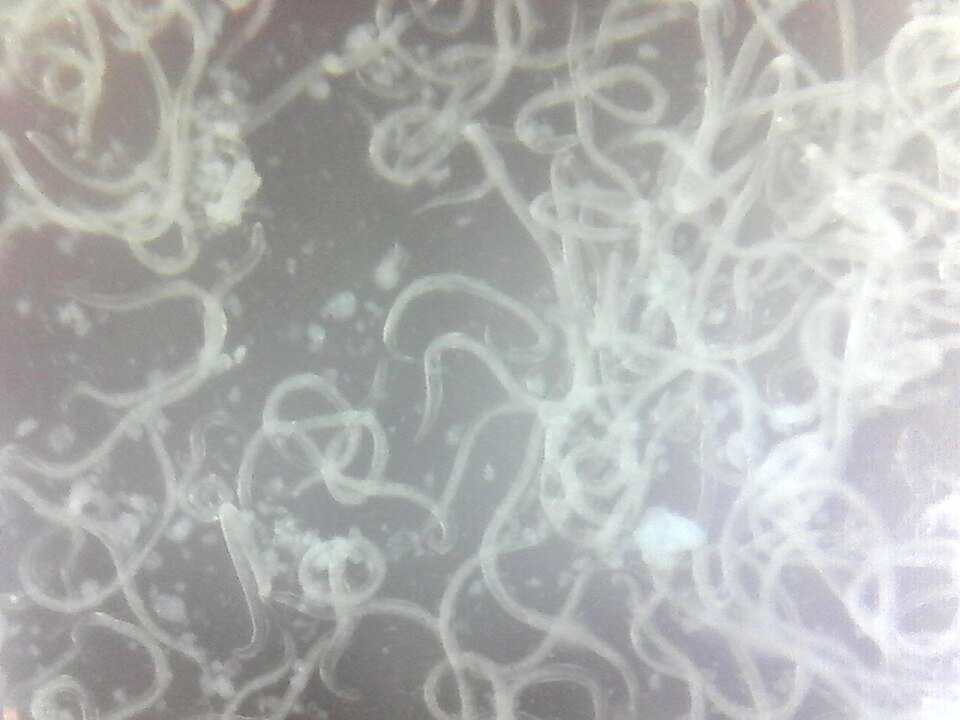
Steinernema feltiae
Overview
Steinernema feltiae is an entomopathogenic nematode used mainly against sciarid fly larvae in protected crops, propagation areas and damp growing media.
It is applied as a living biological drench and works best when the growing media remains evenly moist before and after application.
Type
Entomopathogenic nematode.
Target pests
Primary targets
- Sciarid fly larvae
- Fungus gnat larvae
Secondary uses
- Some soil-dwelling pest stages
- Some thrips pupal stages in growing media
Why Steinernema feltiae is important
Sciarid fly larvae live in the growing media, where many foliar biological control agents cannot reach them.
Steinernema feltiae gives growers a direct biological option for reducing larvae in the substrate, especially in propagation, young plants, herbs, ornamentals and other crops where damp media encourages sciarid activity.
How it works
The nematodes move through the moisture film in the growing media and search for susceptible insect larvae.
Once inside the host, they release symbiotic bacteria that kill the pest. The nematodes then reproduce and move on to find further hosts while conditions remain suitable.
Environmental requirements
Moisture
Moisture is critical.
The growing media should be evenly moist before application and kept moist afterwards. Dry media reduces nematode movement and survival.
Temperature
Best performance is usually in moderate protected-crop temperatures.
Very cold or very hot conditions reduce activity.
Light
Avoid exposure to direct sunlight and UV during application.
Apply as a drench or through clean irrigation systems where possible.
Crops commonly used in
- Herbs
- Lettuce
- Ornamentals
- Propagation crops
- Young plants
- Nursery crops
Strengths
- Targets larvae in the growing media
- Useful in propagation and young plant areas
- Compatible with many residue-sensitive systems
- Can be used curatively
- Works well with soil predators
Limitations
- Requires moist growing media
- Poor performance in dry substrates
- Sensitive to UV and desiccation
- Needs careful application
- Does not control adult sciarid flies directly
Works well with
Soil predators provide longer-term background suppression, while nematodes can give a more direct curative reduction of larvae.
Common reasons for failure
Media too dry
Nematodes need moisture to move and find hosts.
Poor application coverage
Uneven drenching leaves untreated zones where larvae survive.
UV exposure
Nematodes should not be exposed to strong light during application.
Incompatible tank mixes
Some chemicals, fertilisers or residues may reduce survival.
Practical IPM strategy
A strong sciarid fly programme usually combines:
- Hygiene and algae control.
- Moisture management.
- Yellow sticky trap monitoring.
- Soil predators for background suppression.
- Steinernema feltiae drenches when larvae are active.
This approach is stronger than relying on nematodes alone.