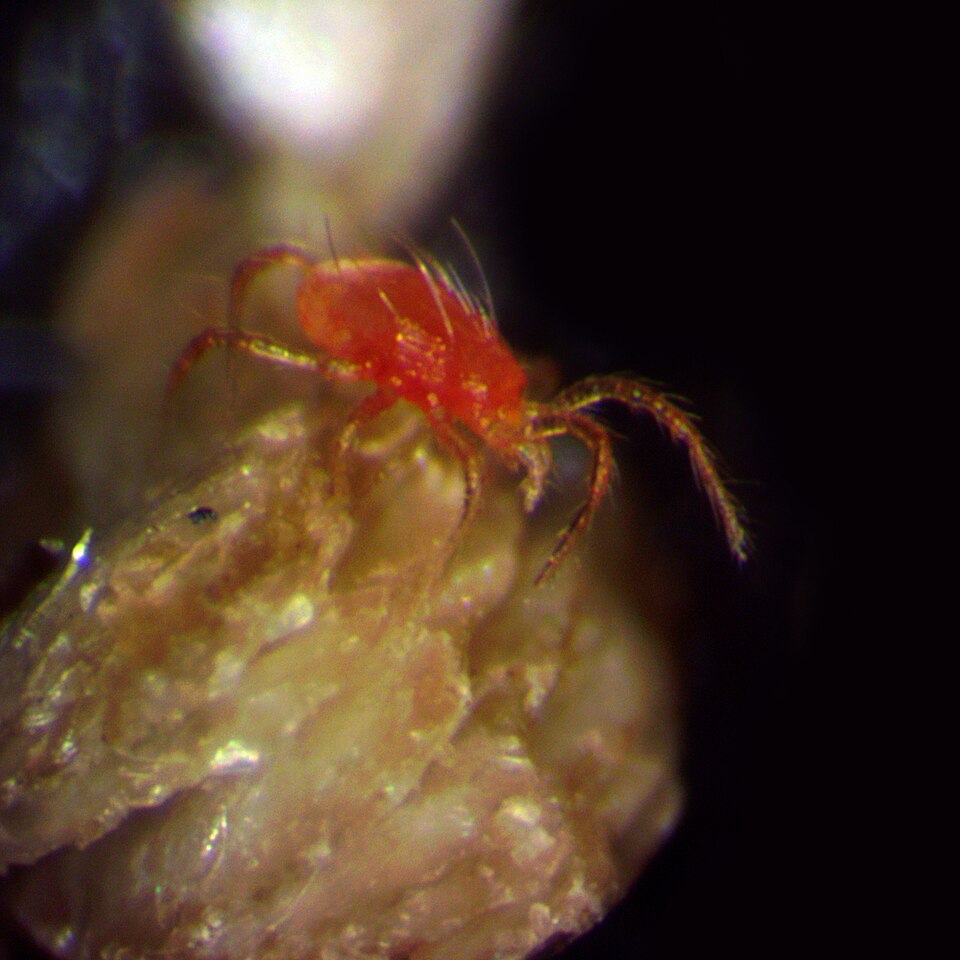
Phytoseiulus persimilis
Overview
Phytoseiulus persimilis is the most widely used specialist predator of two-spotted spider mite in commercial horticulture. It is capable of rapidly locating spider mite colonies and can provide excellent curative control when introduced early enough.
Unlike generalist predatory mites, Phytoseiulus is highly specialised and depends largely on spider mites for survival and reproduction.
Type
Specialist predatory mite.
Target Pests
Primary Targets
- Two-spotted spider mite
- Spider mites
Secondary Targets
- Limited survival on some related mite species
Identification
Adults are bright orange-red predatory mites and are usually larger and more active than spider mites.
Eggs are oval, transparent to pale orange and are often found within spider mite colonies.
Nymphs resemble smaller versions of the adults.
Why Phytoseiulus is Important
Spider mites can reproduce extremely quickly under warm conditions and may cause severe crop damage before infestations become obvious.
Phytoseiulus can consume multiple spider mite eggs, larvae and adults each day and is capable of rapidly increasing its own population when prey is abundant.
Environmental Preferences
Temperature
Optimal performance:
- 20–30°C
Reduced activity:
- Below 15°C
Humidity
Preferred:
- Above 60% RH
Performance may decline under prolonged hot, dry conditions.
Crop Environment
Performs best where spider mite colonies are present and humidity is not excessively low.
Crops Commonly Used In
- Strawberries
- Cucumbers
- Ornamentals
- Peppers
- Soft fruit crops
Strengths
- Exceptional spider mite predator
- Rapid population growth
- Strong searching behaviour
- Proven commercial performance
- Excellent curative potential
Limitations
- Requires spider mites to survive
- Poor preventative choice
- Reduced performance in very dry conditions
- Can collapse once prey is exhausted
Works Well With
- Amblydromalus andersoni
- Amblyseius swirskii
- Predatory mite programmes
- Good crop hygiene and monitoring
Monitoring Establishment
Successful establishment can often be confirmed by:
- Predator eggs within spider mite colonies
- Active orange-red predators on infested leaves
- Reduced spider mite egg numbers
- Slower development of webbing
- Increased predator-to-prey ratios
Inspect known hotspots weekly.
Common Questions
How quickly does Phytoseiulus work?
Under suitable conditions visible improvement may be seen within one to three weeks.
Can it survive without spider mites?
Not for long. It is highly specialised and depends on spider mites.
Can it be used preventatively?
Usually no. Generalist predatory mites are normally better preventative options.
Does it work in hot weather?
Yes, but prolonged hot and dry conditions may reduce performance.
Common Mistakes
Introducing too late
Heavy webbing and severe infestations are harder to control.
Insufficient monitoring
Spider mite hotspots can develop rapidly.
Using incompatible pesticides
Some residues can harm predator populations.
Expecting preventative control
Phytoseiulus is generally most effective after spider mites are detected.
Practical Crop Examples
Strawberries
Inspect lower leaves weekly and target hotspots immediately.
Cucumbers
Monitor around vents and warm areas where outbreaks often begin.
Ornamentals
Focus on known infestation zones and maintain regular scouting.