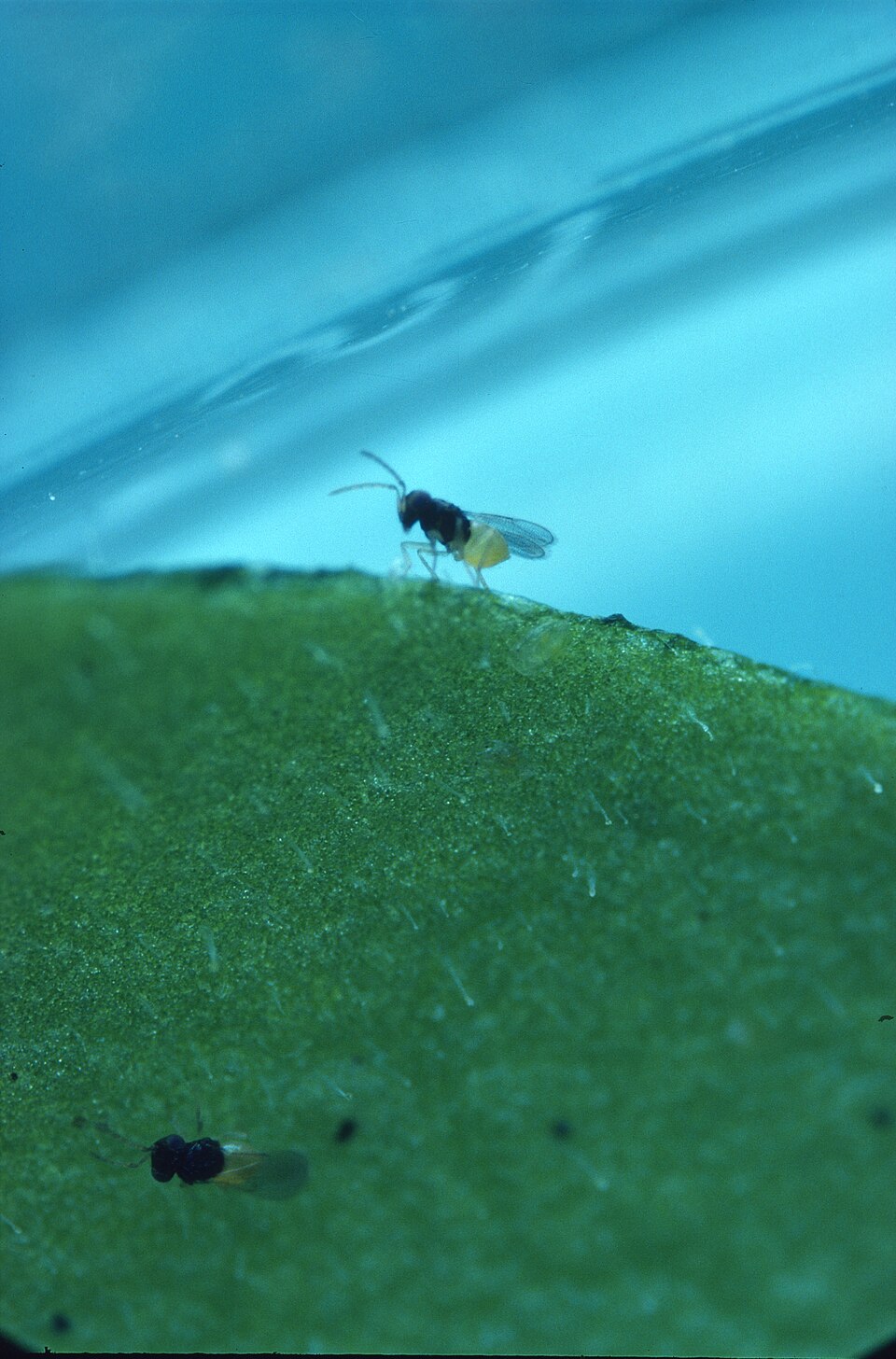
Encarsia formosa
Overview
Encarsia formosa is one of the most widely used biological control agents for whitefly management in protected horticulture. It is a parasitoid wasp that attacks developing whitefly stages and has formed the foundation of greenhouse whitefly programmes for decades.
When introduced early and supported by regular monitoring, Encarsia can provide season-long suppression of whitefly populations.
Type
Parasitoid wasp.
Target Pests
Primary Targets
- Glasshouse whitefly
- Whitefly
Secondary Targets
- Some related whitefly species
Identification
Adults are tiny black parasitoid wasps approximately 0.6 mm long.
Parasitised whitefly scales become black and are commonly known as "black scales" or "mummies".
These black scales are often the easiest way to assess establishment.
Why Encarsia is Important
Whitefly populations can increase rapidly and cause direct feeding damage, honeydew contamination and virus transmission.
Encarsia attacks developing whitefly stages and can establish self-sustaining populations under suitable greenhouse conditions.
Environmental Preferences
Temperature
Optimal:
- 20–28°C
Reduced activity:
- Below 17°C
Light
Good light levels improve activity and host searching.
Crop Stability
Stable greenhouse environments favour long-term establishment.
Crops Commonly Used In
- Tomatoes
- Cucumbers
- Ornamentals
- Poinsettia
- Nursery crops
Strengths
- Proven commercial performance
- Excellent whitefly specialist
- Easy monitoring through black scales
- Long-term establishment possible
- Compatible with many IPM programmes
Limitations
- Works best when introduced early
- Less effective during severe outbreaks
- Sensitive to pesticide residues
- Slower than chemical knockdown
Works Well With
- Amblyseius swirskii
- Eretmocerus eremicus
- Macrolophus pygmaeus
- Whitefly monitoring programmes
Monitoring Establishment
Successful establishment can often be confirmed by:
- Black parasitised whitefly scales
- Adult parasitoids visible on leaves
- Reduced whitefly population growth
- Increasing parasitism rates
Inspect lower and middle canopy leaves regularly.
Common Questions
How do I know Encarsia is working?
Look for characteristic black scales containing developing parasitoids.
How quickly does Encarsia work?
Visible parasitism may take several weeks depending on crop conditions and whitefly density.
Can Encarsia control severe whitefly outbreaks?
It works best when introduced early. Severe infestations often require additional biological controls.
Can Encarsia survive without whitefly?
No. Whitefly hosts are required for reproduction.
Common Mistakes
Introducing too late
Large established populations are harder to suppress.
Poor monitoring
Whitefly hotspots may be missed.
Incompatible pesticides
Parasitoids are highly sensitive to many residues.
Stopping releases too early
Population build-up often takes time.
Practical Crop Examples
Tomatoes
Often combined with Macrolophus for season-long whitefly suppression.
Cucumbers
Frequently combined with Swirskii to target multiple whitefly life stages.
Ornamentals
Used preventatively where whitefly pressure is historically expected.
Encarsia vs Eretmocerus
Encarsia
- Traditional whitefly parasitoid
- Excellent establishment
- Easy monitoring through black scales
Eretmocerus
- Often stronger in warmer crops
- Complements Encarsia programmes
- Useful for broad whitefly strategies
Related Pests
Related Crop Modules
Related Solution Pages
Use this page alongside
- Eretmocerus eremicus
- Amblyseius swirskii
- Macrolophus pygmaeus
- Biocontrol Tool
- Release Planner
- Risk Engine